

Guardrails and End Terminals: Enhancing Roadside Safety
Introduction
Guardrails play a crucial role in roadside safety by preventing vehicles from encountering hazards such as rigid objects, steep slopes, cliffs, or bodies of water. These protective barriers are strategically installed along highways, bridges, and curves to reduce the severity of collisions. In this article, we’ll delve into the topic of guardrails, focusing specifically on guardrail terminals—the critical components that mark the beginning or end of a guardrail system.
Learn more about Qforensics’ team of guardrail accident forensic engineers.
Guardrail Face: Redirecting Vehicles Safely
The guardrail face is the visible part of the barrier that faces the road. Its primary purpose is to redirect a vehicle back onto the roadway if it veers off course. Here are some key points about guardrail faces:
1. Composition: Most common guardrail designs feature galvanized steel w-beam panels that designers lap and connect using rigid splice bolts. Alternative designs include concrete barriers and cable barriers.
2. Considerations: There is no single “best” barrier system. Each has its own benefits and potential drawbacks that make it better suited to specific applications.
- Cable Barrier: High-tension Cable Barrier is often the preferred choice in relatively wide medians or on roadsides where there is sufficient “safe space” beyond the barrier location. Cable barriers have the greatest dynamic deflection of the three most prominent barrier types and are thus more forgiving for the occupants of the impacting vehicle. While dynamic deflection is desirable in locations that allow for it, many locations where barrier is installed feature hazards that are located just beyond the barrier.
- W-Beam Guardrail: W-beam guardrails serve as semi-rigid barriers. It still allows for some dynamic deflection, thus reducing the impact forces exerted on occupants.
- Concrete Barrier: A concrete barrier is considered a rigid barrier. It has essentially no dynamic deflection (except for precast, temporary barriers, which can move somewhat when struck). This makes concrete barriers the least forgiving for the occupants of an impacting vehicle, but also the only option for many situations where no room for dynamic deflection exists because the hazard is located immediately beyond the barrier.
End Terminals: Absorbing Kinetic Energy

While guardrails are meant to protect drivers from roadside hazards, they can become a hazard themselves, particularly at their ends. The ends of these guardrails are secured with rigid anchors, leaving narrow, relatively sharp ends exposed during a vehicle collision. The terminals, located at the beginning and end of a guardrail system—especially within the clear zone for oncoming traffic—are crucial. Their primary purpose is to anchor the guardrail to redirect impacting vehicles while minimizing the severity of the impact. Let’s take a closer look at end terminals:
1. Energy-Absorbing Guardrail Terminals:
These designs use various means to dissipate energy, gradually decelerating an impacting vehicle. Typically, these types of terminals achieve absorption by extruding the guardrail through an impact head. This impact head kinks, cuts, or crushes the guardrail as it passes through.
2. Gating End Terminals:
Gating end terminals are designed to allow a vehicle to pass if struck near the end. These terminals function as redirective barriers beyond a certain distance from the terminal’s end.
Crashworthiness Testing
Guardrail systems undergo rigorous crash tests to assess their performance. These tests simulate real-world collisions and evaluate factors such as occupant safety, vehicle redirection, and structural integrity. The results guide improvements in guardrail design and installation practices.
Global Safety Standards
Several safety standards govern guardrail design and installation worldwide. Notable ones include:
1. NCHRP Report 350:
-
- The Manual for Assessing Safety Hardware (MASH) have replaced the Report 350’s crash testing standards. However, they still apply to many older installations.
2. AASHTO MASH:
-
- Developed by the American Association of State Highway and Transportation Officials (AASHTO). MASH provides guidelines for crashworthy guardrail systems.
- The current crash test standard for safety hardware used on new construction in the U.S. is MASH.
3. EN 1317 (European Standard):
-
- EN 1317 outlines requirements for road restraint systems in Europe.
- It covers various performance levels and impact scenarios.
Legal Liability in Guardrail and End Terminal Impacts
When functioning properly, guardrails redirect vehicles and lessen the severity of collisions with rigid objects and other roadside hazards. Similarly, end terminals protect drivers and save lives by preventing the blunt and relatively sharp guardrail end from impaling an impacting vehicle. However, design defects, improper installations, and improper placement can sometimes yield devastating results.
Design
Although the crash test standards referred to above are generally quite effective at keeping dangerous or inadequate designs off public roadways, changes to design parameters after testing or selective reporting of biased crash test samples can lead to the installation of inferior products. While occasional negative crash outcomes are unavoidable due to the unpredictable nature of roadway departures and high variability in impact conditions, it is important to consider the potential reasons behind a severe crash outcome:
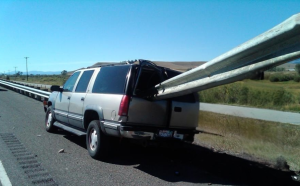 What type of guardrail terminal was hit?
- Does that terminal have any known issues or prior litigation associated with it?
- What are those issues, and are they applicable to the present crash?
- Was the terminal installed correctly?
- Were the impact conditions within typical limits to ensure acceptable product performance?
These questions can help determine if severe or fatal injuries from a guardrail or terminal impact were exacerbated by dangerous conditions concealed within the device itself.
Installation/Placement
- In addition to deficiencies in guardrail design, issues related to location, installation, maintenance, and repair can also expose drivers to hazardous conditions. Often, the entity responsible for maintenance and repair may not be immediately evident. It may be necessary to obtain discovery documents to determine whether a government agency or a private contractor is responsible for guardrail maintenance and repair in that area. It is common for a state Department of Transportation (DOT) to enter into agreements with private contractors to maintain and repair guardrails within defined regions. These contracts should specify whether the contractor is responsible for routine inspections at specified intervals or only for repairs after they are notified of the work needed. Due to the high risk associated with damaged and unsafe guardrails along traveled roadways, many states have established standards for repair procedures and timelines.
- Installation of a roadside or median barrier is initiated either by satisfying one or more warrants or by an engineering study evaluating various factors that determine the appropriateness of guardrail installation. These warrants are described in the roadway or roadside design manual of the respective state where the guardrail is to be installed. Additionally, the AASHTO Roadside Design Guide provides national guidance.
- In many situations, the lack of a warranted guardrail may leave the state DOT, the roadway project design engineer, or even the contractor liable for accidents that occur due to the absence of a barrier that should have been installed according to relevant design standards. Standards based on factors such as the type of roadside hazard, the distance to the hazard, and median width usually offer definitive criteria for determining whether a guardrail is required, recommended, or optional. Factors such as crash history and roadway curvature may require a more thorough engineering analysis to determine if guardrail installation is necessary.
Conclusion
Guardrails, along with their end terminals, are unsung heroes of roadside safety. By redirecting vehicles and reducing crash severity, they provide the potential for saving lives and preventing catastrophic accidents. As we continue to improve our transportation infrastructure, let’s appreciate the silent guardians that keep us safe on the roads, while also remaining vigilant to root out dangerous conditions present in some guardrail installations even today. Learn more about Qforensics’ team of guardrail accident forensic engineers.
___________________________________________________________________________________________________
Note: the information provided in this article is based on industry standards and practices. Always follow local guidelines and regulations when designing, installing, or maintaining guardrail systems.
 About the Author:
Mitchell Chermak is a Mechanical Engineer with Quality Forensic Engineering. He specializes in accident reconstruction and forensic engineering research and analysis. Mr. Chermak has been reconstructing vehicle accidents since 2018. During this time, he has analyzed many cases involving roadside safety and guardrail design, installation and performance.
About Qforensics
Quality Forensic Engineering, LLC is a full-service forensic engineering firm providing engineering support to clients in accident reconstruction, biomechanics, fire investigations, patent litigation analysis, premises liability, product liability, and tire failure analysis. We use the latest technology and industry-proven techniques to provide thorough analysis, expert testimony, and conclusions for the most difficult engineering questions. Our forensic engineers support clients throughout the U.S. View our locations
Submit a Case Online Contact Us Download eBrochure
